

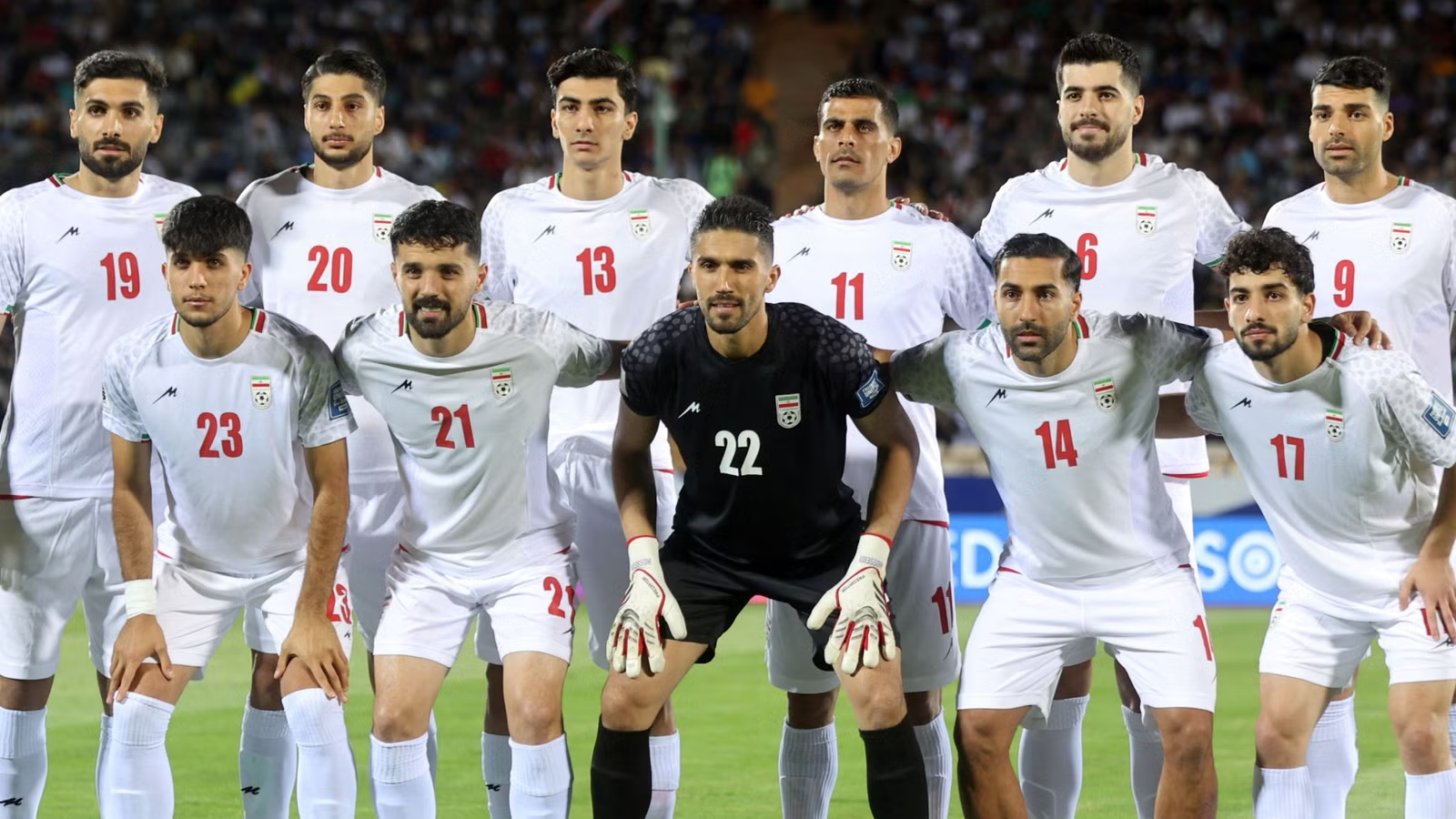
The participation of Iran national football team at the FIFA World Cup 2026 is facing unprecedented uncertainty as renewed military tensions between Iran and the United States spill into the sporting arena.
Iran qualified for the expanded 48-team tournament through the Asian Football Confederation and was drawn into Group G alongside Belgium, New Zealand, and Egypt. The team was scheduled to play group matches in Los Angeles and Seattle this June. Recent U.S. military strikes on Iranian targets and the broader regional escalation, however, have raised serious diplomatic, security, and logistical concerns that could jeopardize Iran’s participation.
Iranian Officials Signal Possible Withdraw
Iranian football authorities have publicly acknowledged that withdrawal is now a possibility. Mehdi Taj, president of the Iranian Football Federation, told Iranian state media that under the current circumstances, “it is unlikely” Iran will participate in a tournament hosted on U.S. soil, citing safety considerations and the prevailing political context.
With fewer than four months until Iran’s opening fixture against New Zealand on June 15, the comments mark an extraordinary development and have triggered urgent coordination among tournament organizers, national associations, and host-city authorities.
FIFA’s Position: Situation Under Review
FIFA has confirmed it is closely monitoring developments. Secretary-General Mattias Grafström said FIFA’s priority remains delivering a safe, inclusive World Cup and that it is maintaining dialogue with all stakeholders, including the host nations, the United States, Canada, and Mexico.
No formal decision has been taken regarding Iran’s status. FIFA officials have stressed that it is “premature to comment in detail” while the broader geopolitical situation continues to evolve.
Potential Impact on the Tournament
A withdrawal by Iran would have wide-ranging consequences:
- Scheduling: Group G fixtures could require rescheduling, relocation, or cancellation.
Replacement scenarios: Under FIFA regulations, another AFC nation — such as Iraq or the UAE — could be considered if Iran officially withdraws. - Fans and travel: Ticket holders for Iran’s matches may face uncertainty over refunds or reassignment.
- Commercial implications: Broadcasters and sponsors are preparing contingency plans to avoid programming gaps.
- Sporting integrity: Any withdrawal could prompt review under FIFA statutes, though enforcement in extraordinary political circumstances is complex.
How Tensions Reached This Point
Political strains between Iran and the United States have intersected with football before. Iran previously threatened to boycott the World Cup draw in Washington over visa issues, though it ultimately took part.
The current crisis is rooted in a broader regional conflict involving U.S. and Israeli military actions, subsequent retaliation, and heightened instability. Iranian officials have cited concerns over player and staff safety, entry permissions, and the appropriateness of competing in the U.S. as central to ongoing deliberations.
A Test for Sport and Politics
The standoff underscores the fragile line global sport walks amid geopolitical crises. While FIFA maintains a stance of political neutrality, security realities, visa regimes, and diplomatic relations are now directly influencing tournament planning and participation.
What to Watch Next
Key developments expected in the coming weeks include:
- A formal decision from the Iranian Football Federation on participation.
- Clarification from FIFA and host governments on security and visa assurances.
- Contingency plans for Group G should be in place in case a replacement is required.
- Reactions from other teams drawn alongside Iran.
Supporters and stakeholders are advised to rely on official FIFA communications for verified updates as the situation continues to unfold.
